
THE LOUVRE IS MORE THAN THE MONA LISA
There is a curious thing that happens when people talk about visiting the Louvre. Almost immediately, the conversation becomes a checklist.
The Mona Lisa. The Venus de Milo. The Winged Victory of Samothrace.
All extraordinary. All deserving of attention. And yet, concentrating only on the Louvre’s most famous treasures risks missing something equally remarkable.
The Louvre itself.
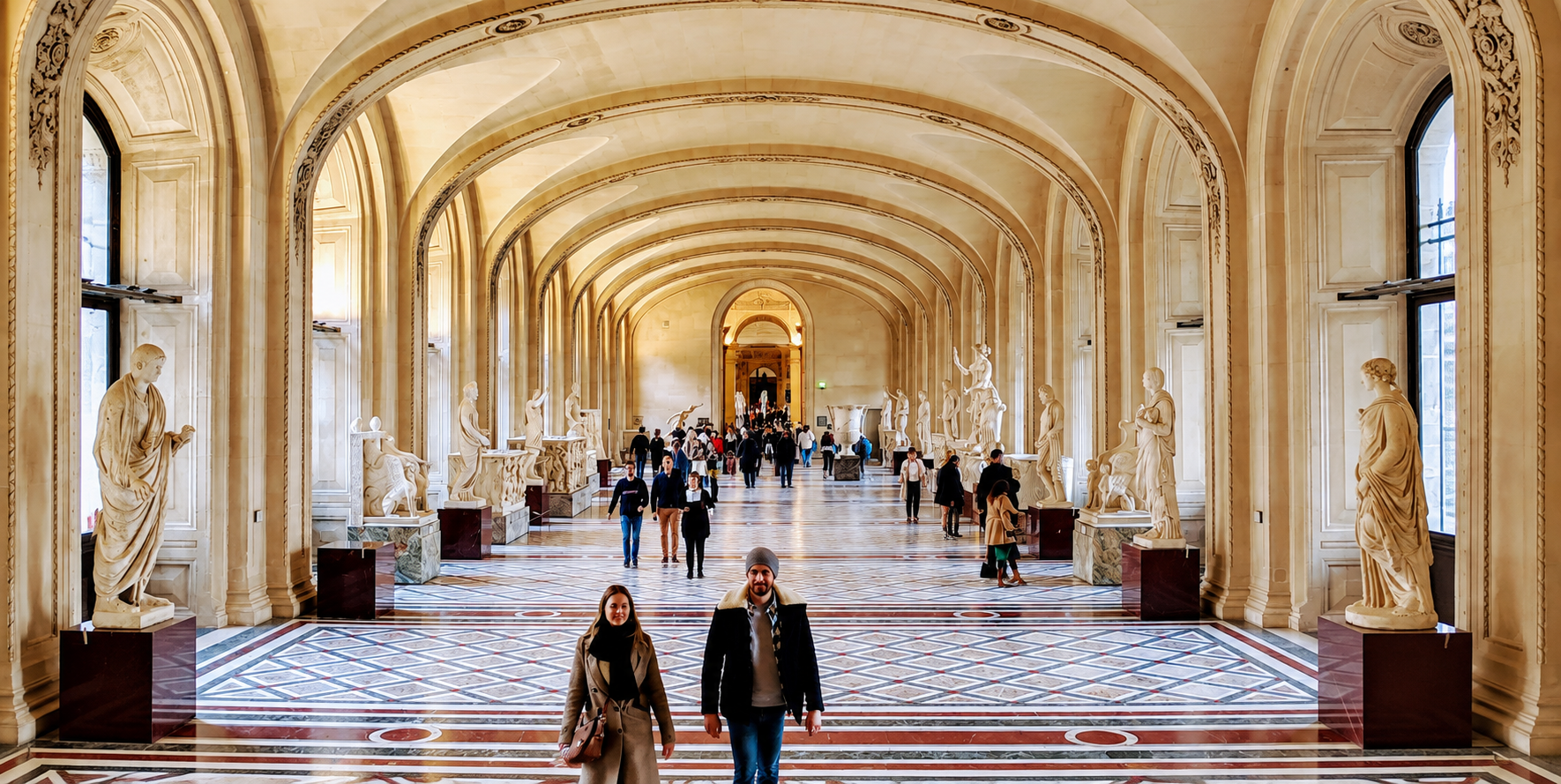
Walk into this extraordinary place with no intention of racing from masterpiece to masterpiece and an entirely different museum begins to reveal itself. The enormous corridors, the staircases, the vaulted ceilings, the courtyards, the galleries that seem to disappear into the distance and the sudden glimpses through doorways into yet another magnificent room become as much a part of the experience as the objects hanging on the walls.
That should hardly be surprising. The Louvre was a palace long before it became a museum.

Its story reaches back to 1190, when Philippe Auguste began constructing a fortress on the western edge of medieval Paris. It later became a royal residence and continued evolving over centuries as successive rulers enlarged, embellished and transformed it. The museum opened in 1793, but the building surrounding its collections still carries the architectural evidence of those earlier lives.
And remarkably, you can go downstairs and meet one of them.
Beneath the grandeur of today’s Louvre are the remains of the medieval fortress. Ancient stone foundations and remnants of the defensive structure survive below the palace, providing one of those wonderful moments when Paris suddenly reminds you that the city beneath your feet is considerably older than the one surrounding you.
Then there are the corridors.
Some are so vast that the building seems determined to compete with its own collection. Paintings line enormous walls beneath decorated ceilings. Sculptures appear at the ends of passageways. Light pours through windows and across polished floors. One gallery leads into another, then another, and somewhere along the way you realize that you have completely forgotten whichever famous painting you had originally been trying to find.
That is when the Louvre becomes interesting.
Instead of marching toward the next masterpiece, wander.
Look through the doorways.
Look up.
Turn around occasionally.
Allow yourself to become distracted.
There are rooms where almost everyone appears to be heading somewhere else, and those can be among the most enjoyable places in the entire museum. While crowds gather around the celebrated works, quieter galleries allow you to stand in front of something you have never seen reproduced in a book and wonder why nobody ever told you about it.
The Louvre itself recommends the quieter Sully and Richelieu wings to visitors spending an entire day at the museum, rather than limiting themselves to the famous works concentrated in Denon.
And then, of course, there is the Pyramid.

What was once startlingly modern against the historic palace has become almost impossible to imagine Paris without.
Do not simply use it as an entrance.
Stand back and look at it.
Walk around it. Watch the old façades appear through its geometric glass. Look at it again later in the day when the light has changed. And if you are fortunate enough to see the Louvre illuminated after dark, linger. The relationship between the glowing glass and the surrounding stone is magnificent.
This is where photography becomes part of the pleasure of the Louvre.
Not simply photographs of famous objects, but photographs that leave somebody wondering what they are looking at and where you found it. An empty corridor disappearing beneath a succession of arches. A staircase dominated by an ancient sculpture. A room where the paintings seem almost secondary to the architecture surrounding them. A glimpse through a doorway. A reflection in glass.
Those are the photographs that tell the story of being there.
And perhaps that is the best way to experience the Louvre.
Give it time.
A morning is better than two hurried hours. A full day is better still. And if museums and history genuinely interest you, there is absolutely nothing excessive about returning for another day. Even the Louvre says seeing everything in one visit is impossible.
Arrive early. The museum currently opens at 9:00 a.m. and recommends advance time-slot booking; opening days and hours vary, so check the official schedule before visiting.
Wear the most comfortable shoes you own.
And bring something else that weighs absolutely nothing.
Childlike curiosity.
Forget, for a while, about seeing what everybody tells you that you must see. Follow a corridor simply because it looks beautiful. Walk into a gallery because something at the far end catches your eye. Go downstairs and discover the stones of the medieval fortress. Look through windows. Study ceilings. Sit occasionally and simply absorb the scale of the place.
Of course, go and see the Mona Lisa.
Stand before the Venus de Milo.
Climb the magnificent staircase toward the Winged Victory of Samothrace.

They are famous for very good reasons.
But when you eventually walk back out into Paris, I suspect some of the things you remember most vividly may be the things you never intended to see at all.
Because the greatest mistake you can make at the Louvre is treating the building merely as somewhere that houses masterpieces.
The Louvre is one of them.
CONTINUE THE JOURNEY
Travel does not end with the story. At Vuitton Travel, everything we write about is part of a much larger world of places, experiences and journeys shaped by firsthand knowledge and decades of travel.
Visit Vuitton Travel to explore our growing collection of journeys across Africa, Europe and the Middle East, discover the destinations we know personally, and find inspiration for wherever you may be thinking of going next.
Follow Vuitton Travel on Facebook for new stories, photographs, destination discoveries and inspiration from the road. On LinkedIn, follow Kenneth Vásquez for travel stories, industry perspectives and the experiences and ideas that continue to shape Vuitton Travel.


